Tilbury Douglas technical director Mark Buckle explains how the contractor became the first to deploy a humanoid robot on site and why AI will always need human oversight.
“Technology has moved so quickly that it almost caught us by surprise,” says Buckle. “When we started to see these robots dancing on the telly, we thought the technology had got there three years earlier than what we expected.”
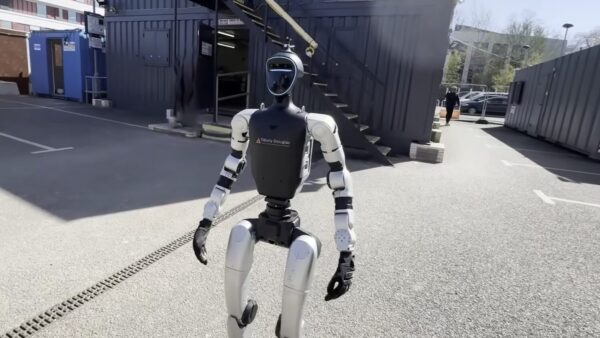
Last month, Tilbury Douglas became the first contractor to put a humanoid robot on a live construction site. If you watch the video accompanying the announcement, you’ll see the robot (named Douglas) moving around a construction site, avoiding pallets and other obstacles, even shaking hands with a worker.
It was only a year prior that Buckle and his team began discussions around what a humanoid site assistant robot might look like. Given they already had an AI framework, a model they had been developing since 2020, plugging their job-specific intelligence into an off-the-shelf robot made sense; it would require a robust roadmap before Douglas could take his first steps on site. “We set those parameters very early, we worked backwards,” Buckle recalls. “Everybody thought we were a bit ‘out there’ at the time, but it’s easy when you identify what people will adopt, what they want, and then you go and do it.”
Strong engagement and clear communication with the workforce were key to Buckle’s approach, with site workers consulted early on and throughout. They were asked how the robot could ultimately help them. Douglas’s strategy would then be founded on three pillars: defect identification, safety monitoring and progress reporting.
Human input
Having an autonomous humanoid robot strolling onto a construction site is perhaps the biggest, symbolic indication of the threat technology poses to people’s jobs.
Buckle is quick to say that technology will always require human input. “It’s not there to replace people,” he says. “If we went out and said we’re going to recreate a robotic site manager, then of course, the resistance would be significant.
“The skill set within our site managers is so multifaceted these days. We need their skill set. You can’t replace 20 years of experience of a site manager with a robot. You cannot do that.
“It’s just not viable, and it’s not right either. And as with any AI, you need human oversight. That’s the biggest thing. We must have human involvement here, even when Douglas does produce his reports; these have human oversight to read them and check them.”
Resistance can also come from staff when they think they’re being watched. However, monitoring is a big part of what Douglas does – its 360-degree camera and LiDAR system essentially operates to spot hazards on site, defects and capture progress, but to a wary workforce this could be considered monitoring. “The one thing we’re always adamant about is the use of ethical AI,” Buckle counters. “It’s not there to spy on people, it’s not there to do that. So, we insist that everyone is blurred out. No one wants to feel they’re being spied on by a robot.”
An off-the-shelf robot
Douglas is a collaborative project with external stakeholders (Buckle is unable to share the partner list at this stage). The robot itself was off-the-shelf from the Chinese manufacturer Unitree, specifically the G1 model.
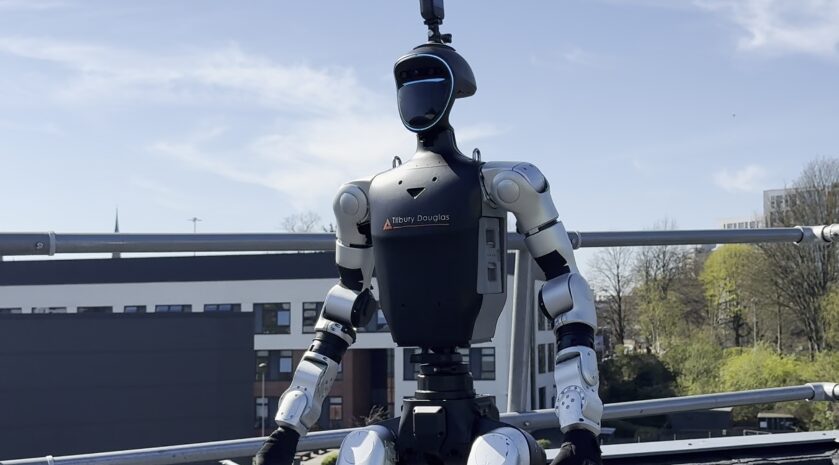
The G1 weighs approximately 35kg, is 130cm tall, and has movement and flexibility at several points, including the shoulders, elbows, wrists, hips, knees and ankles. Overall, it can have up to 43 joint motors, affirming its humanoid tag. Douglas also incorporates a LiDAR and depth camera for ethical monitoring and observation, producing real-time 3D environment mapping and obstacle detection.
The G1 operates on Unitree’s in-house AI agent, UnifoLM, which focuses on perception, reasoning and physical action. Learning through imitation, it can understand physics and environments, ideal perhaps for the terrain of a construction site, and suggests why it was Buckle’s choice. From here, Tilbury Douglas was able to add its own job-specific AI, including site inspection and hazard spotting, the foundation of Buckle’s defects, progress and safety strategy.
CM asked Buckle how much has been invested so far; while he doesn’t give specific numbers, he responds with an everyday comparison: “The best way to describe it is it costs about the same as a normal family car.”
Battery limitations
One thing that hasn’t kept pace with technology is battery power. Like EV cars, mobile phones and laptops, there’s always a need for a plug socket nearby, and Douglas is no exception. One full charge gives approximately two hours of power; there are two fully charged batteries on hand to swap in and out, maintaining continuity of work. Looking ahead, Buckle suggests a wider breakthrough around battery life will come from those developing longer ranges for electric vehicles, but until then, he accepts the battery issue as “probably the main limitation”.
Despite Douglas’ impressive range of movements, stability remains a slight issue. The PR video shows the robot navigating the tricky terrain of a construction site, and now, while trials are ongoing, Douglas only operates autonomously in a test area at a site in Birmingham. Outside of this, the robot is always accompanied by a handler and has “a big emergency stop button”.
Douglas weighs around 35kg and, Buckle says, could do reasonable damage to plasterboard or easily walk through a glass pane. “It’s not different to bringing in autonomous diggers. We’ve really got to think outside the box when it comes to safety.”

While AI and robotics are on the Health & Safety Executive’s agenda, any concrete legislation seems some way off. Until then, Buckle works closely with Tilbury Douglas’s safety team to hone risk assessments appropriately, including how to make Douglas more visible – this might involve a beacon or simply painting the robot in a highly visible colour. “It’s safety-led. Whenever you trial any technology, safety is paramount,” he affirms.
Significant moment
Now, Douglas is ‘on tour’, making appearances at sites around the UK. The next 12 months will include further trials and feedback, working closely with their partners.
Given it was only a year ago that Douglas was an idea, how does he feel seeing the robot taking steps on a construction site? He compares it to a significant moment in consumer technology: “I’m going to say it’s very much like that time in 2008, when the iPhone came out, and everybody had a BlackBerry.”
It’s unclear who or what the BlackBerry is in this instance, or whether the G1 robot will become ubiquitous on construction sites in the next 10 years, but there’s no doubt this is an important step for the construction sector as it adopts robotic technology.
Watch this space.
The post Tempering the robot revolution appeared first on Construction Management.