Sydney student challenge gives future construction leaders hands-on industry experience.
By Anoush Chohilli MCIOB, Ben Lunn and Lily Liu.
Students from leading universities in Sydney and Newcastle, Australia, recently competed in the Tomorrow’s Leaders Student construction challenge, organised by the Sydney CIOB Hub to bridge the gap between academic study and real-world project delivery.
Centred around a guided site tour of the Mirvac One Harbourside development in Sydney, the initiative provided students with direct exposure to a live construction environment before testing their technical knowledge, problem-solving ability and teamwork through a series of industry-focused tasks.
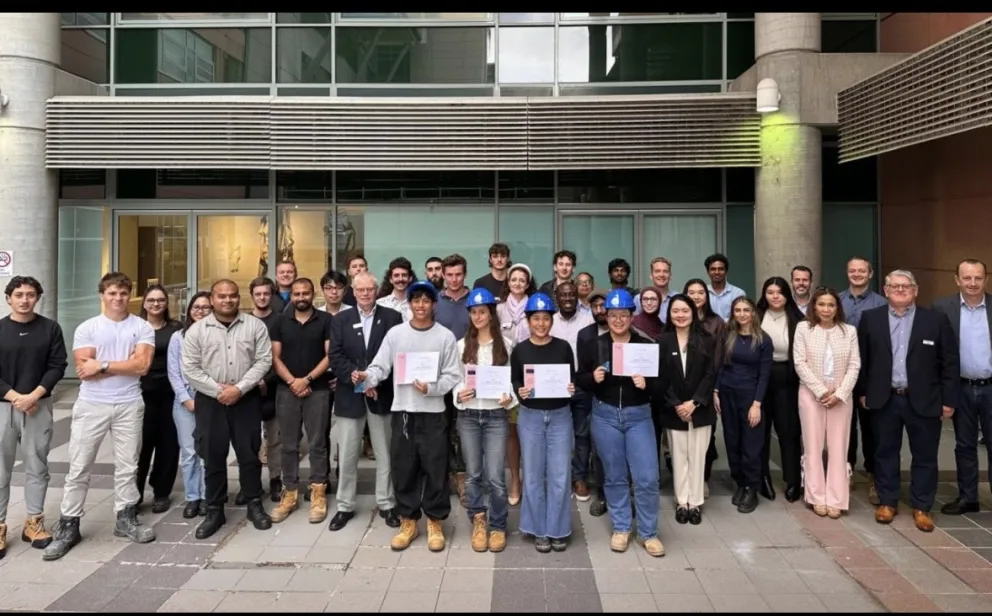
The competition, officiated by CIOB President Paul Gandy and CEO Dr Victoria Hills brought together six teams representing the University of Technology Sydney (UTS), Western Sydney University (WSU), the University of Newcastle (UoN) and the University of New South Wales (UNSW). Each team included students from a range of academic backgrounds, creating a highly collaborative and competitive environment throughout the day.
CIOB Oceania Regional Manager Maricel Cavestany added that “this pilot Student Challenge organised by the Sydney hub demonstrates CIOB’s role in connecting our industry partners with academia and supporting the next generation of construction professionals.”
A practical construction challenge
The competition focused on the construction of a residential apartment building located in the heart of Sydney Harbour. Following a site tour, students were asked to respond to a number of realistic construction and project delivery scenarios based on what they had observed on site.
The first task required teams to develop a construction programme for a post-tensioned suspended slab. Students had to identify key activities, sequencing, and dependencies, while demonstrating an understanding of scheduling, resource allocation, and coordination between trades.
For the second task, teams were asked to design detailed access plans covering delivery routes, equipment positioning, and site entry and exit points. They also identified potential risks, including congestion, pedestrian interaction, and equipment hazards, before proposing mitigation measures and preparing a traffic management plan.
Finally, students prepared a Safe Work Method Statement (SWMS) for the formwork component of a suspended slab, identifying high-risk construction activities, assessing hazards and outlining appropriate control measures in line with workplace health and safety requirements.
Throughout the challenge, students were encouraged to think like construction professionals, balancing project efficiency, safety and sustainability considerations within a limited timeframe.
Innovative solutions under pressure
Teams produced a range of thoughtful and practical solutions, demonstrating both technical understanding and strong collaborative skills.
Many submissions identified critical path activities associated with the suspended slab programme, including formwork, reinforcement, services installation, concrete pouring and curing. Teams carefully considered sequencing and task dependencies to ensure efficient project delivery.
Sustainability also featured strongly in the students’ responses. Proposed measures included the use of low-carbon concrete, reducing material waste, reusing formwork systems and improving energy efficiency on site. These ideas reflected the growing importance of sustainable construction practices across the industry.
Following the challenge, each team presented its findings and recommendations to a judging panel. The presentations tested not only technical capability, but also communication skills, teamwork and the ability to present clear, structured solutions under pressure.
Judges praised the high standard of work produced across all teams, particularly given the short timeframe between the morning site visit and the final presentations.
UTS students Eve Nguyen, Sapphira Chu, Carlos Platon, and Amelia Drougas took out first place, while their fellow UTS team also taking out second place in the competition, with UNSW securing third place.
The winning entries were recognised for their clear analysis, well-structured presentations and practical approach to solving complex construction challenges. Judges particularly noted the students’ ability to balance safety, efficiency and sustainability considerations within their proposed solutions.
Industry exposure and career opportunities
Feedback from students was overwhelmingly positive, with many describing the experience as a valuable opportunity to engage directly with an active construction project and apply classroom learning in a real-world setting.
Participants especially appreciated that the challenge questions were directly linked to the site they had toured earlier in the day, helping to reinforce the practical relevance of the tasks.
In addition to the competition itself, the winning team received paid work placements with four industry organisations, offering opportunities to gain further hands-on experience over periods ranging from four to 12 weeks.
Special thanks were given to Mirvac, Newton Fisher Group, Altus Group and Laing O’Rourke for sponsoring and supporting the initiative.